
Decanter centrifuge
CONTINUOUS SOLID–LIQUID SEPARATION
Decanter centrifuge
Continuous feeding, separation and recovery of both solids and liquid. An internal screw conveys settled solids to the discharge end.
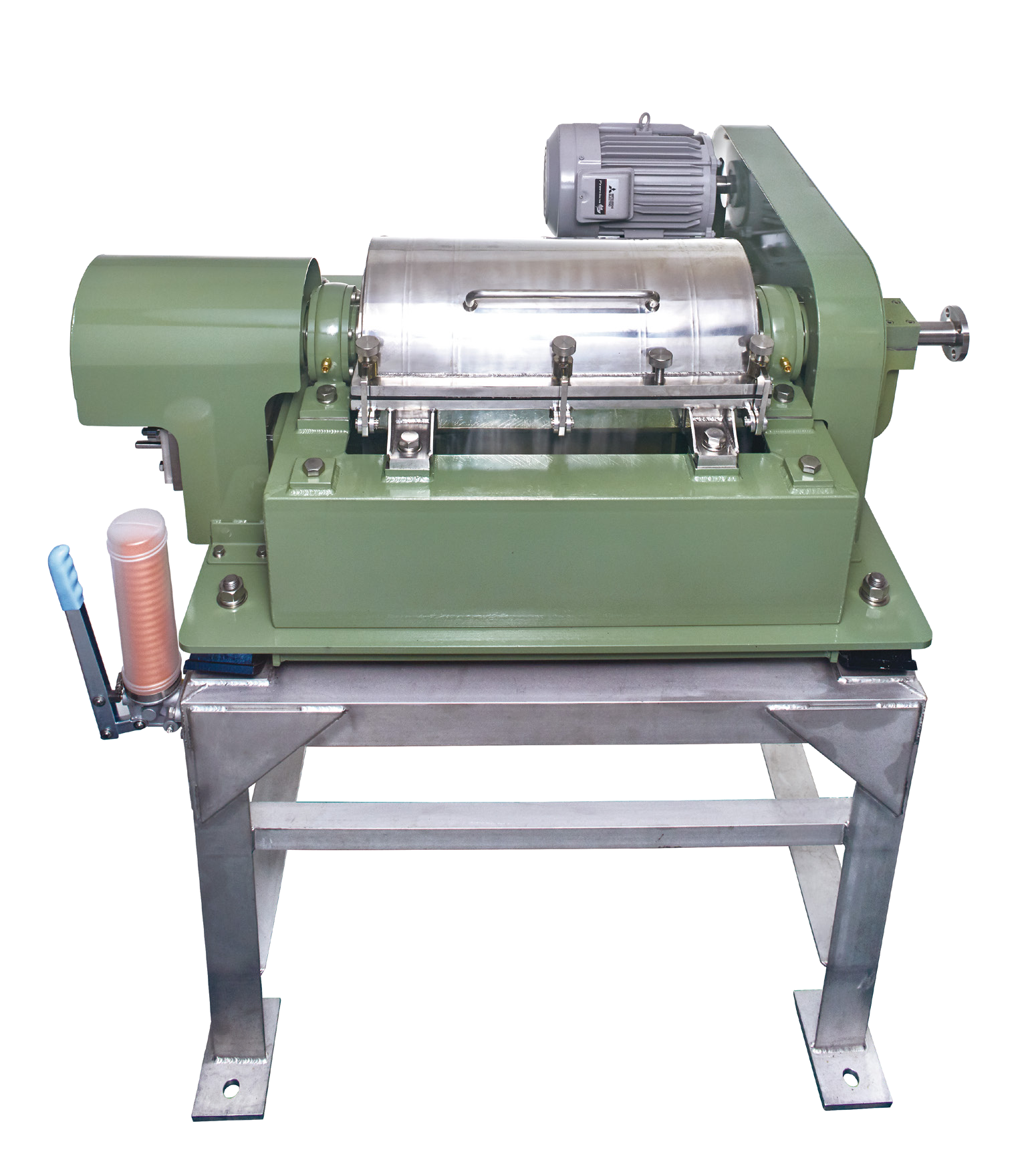
Designed around a continuous process
Continuous solids discharge
The screw conveys solids that settle on the bowl wall, supporting continuous feed, separation and recovery.
No filter cloth
Separation uses centrifugal sedimentation and the density difference between solids and liquid.
Selection for your slurry
Particle size, solids concentration, viscosity and throughput guide the bowl diameter, length and configuration.
From feed to separate solids and liquid streams
-
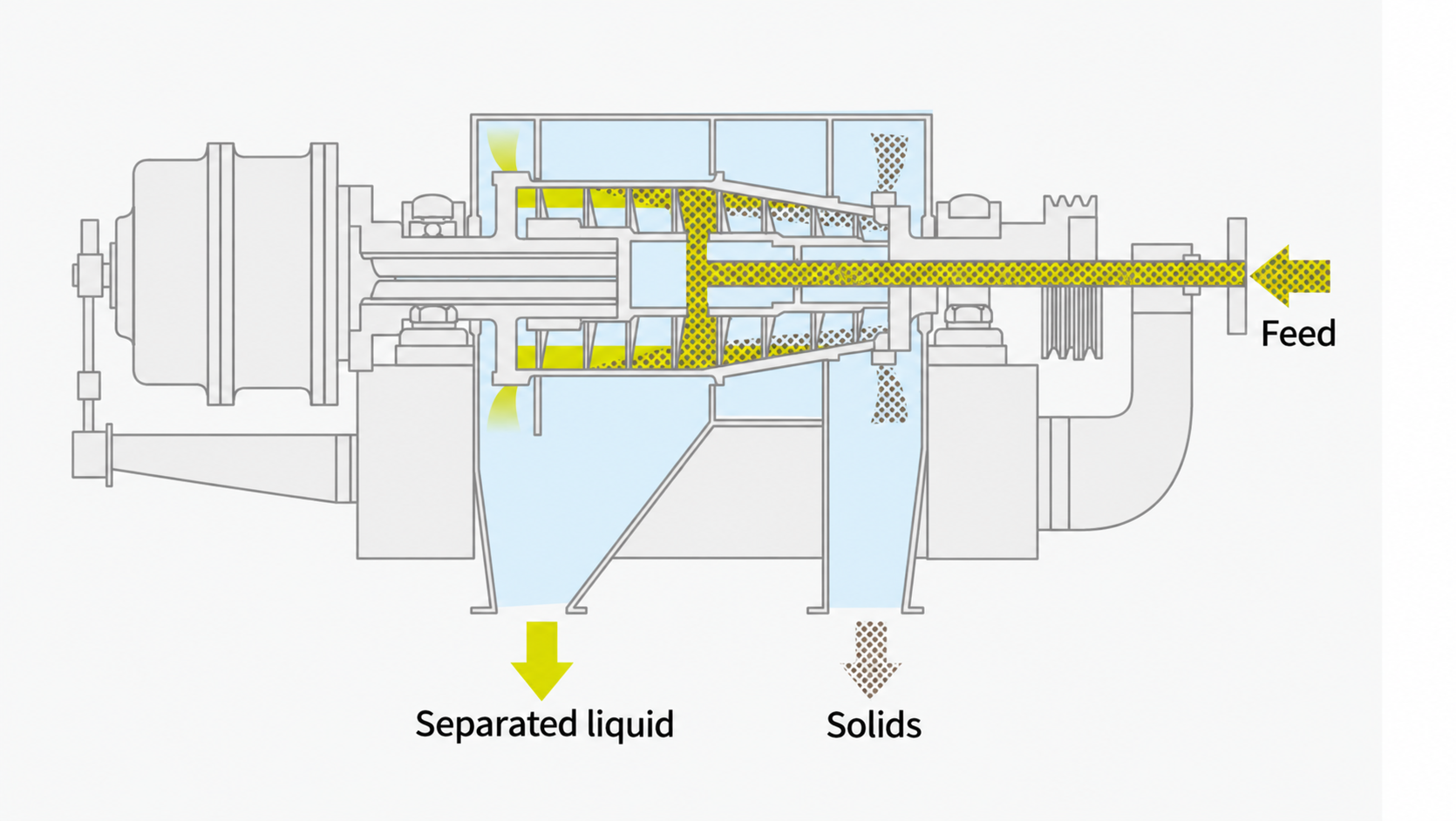
Feed
Feed slurry through the pipe into the rotating bowl.
-
Settle and convey
Solids settle on the wall. A small speed difference between bowl and screw moves the solids towards the discharge end.
-
Recover each fraction
Dewatered solids leave at the conical end, while separated liquid leaves at the opposite end.
The diagram explains the separation principle. Starting, stopping and other operations must follow the actual machine manual.
Models and principal specifications
| Model | Speed (rpm) | RCF (G) | Indicative throughput (m³/h) | Reference weight (kg) |
|---|---|---|---|---|
| AD-150 | 6,000 | 3,200 | 0.5–1 | 400 |
| AD-1502 | 6,000 | 3,200 | 0.5–1 | 500 |
| AD-250 | 4,800 | 3,200 | 1–3 | 600 |
| AD-2502 | 4,800 | 3,200 | 1–3 | 750 |
Throughput values are from the catalog. Actual capacity and separation performance depend on feed properties and operating conditions.
| Model | A (mm) | B (mm) | C (mm) |
|---|---|---|---|
| AD-150 | 1,100 | 1,000 | 450 |
| AD-1502 | 1,200 | 1,000 | 450 |
| AD-250 | 1,700 | 1,500 | 650 |
| AD-2502 | 1,800 | 1,500 | 650 |

Catalog values are reference specifications. Dimensions, weight and operating conditions vary with the configuration. Refer to the drawing and specification for the actual machine when planning installation.
Balance liquid clarity and solids moisture
Changing the opening of the plate dam at the liquid outlet adjusts the balance between clarified liquid and the moisture in recovered solids.
Smaller opening
Liquid clarity tends to improve, while the recovered solids tend to retain more moisture.
Larger opening
Solids tend to contain less moisture, while more solids may remain in the separated liquid.
Results depend on the feed and operating conditions. A sample test helps establish the appropriate balance.
Operating equipment and cleaning options
Standard equipment includes the control panel, frame and grease pump, together with protective devices.
Standard equipment and protective devices
Vibration detector
Stops the machine when abnormal vibration is detected.
Torque limiter
Stops the machine if the screw is subjected to an abnormal load.
Safety sensor
Detects whether the casing is open or closed.
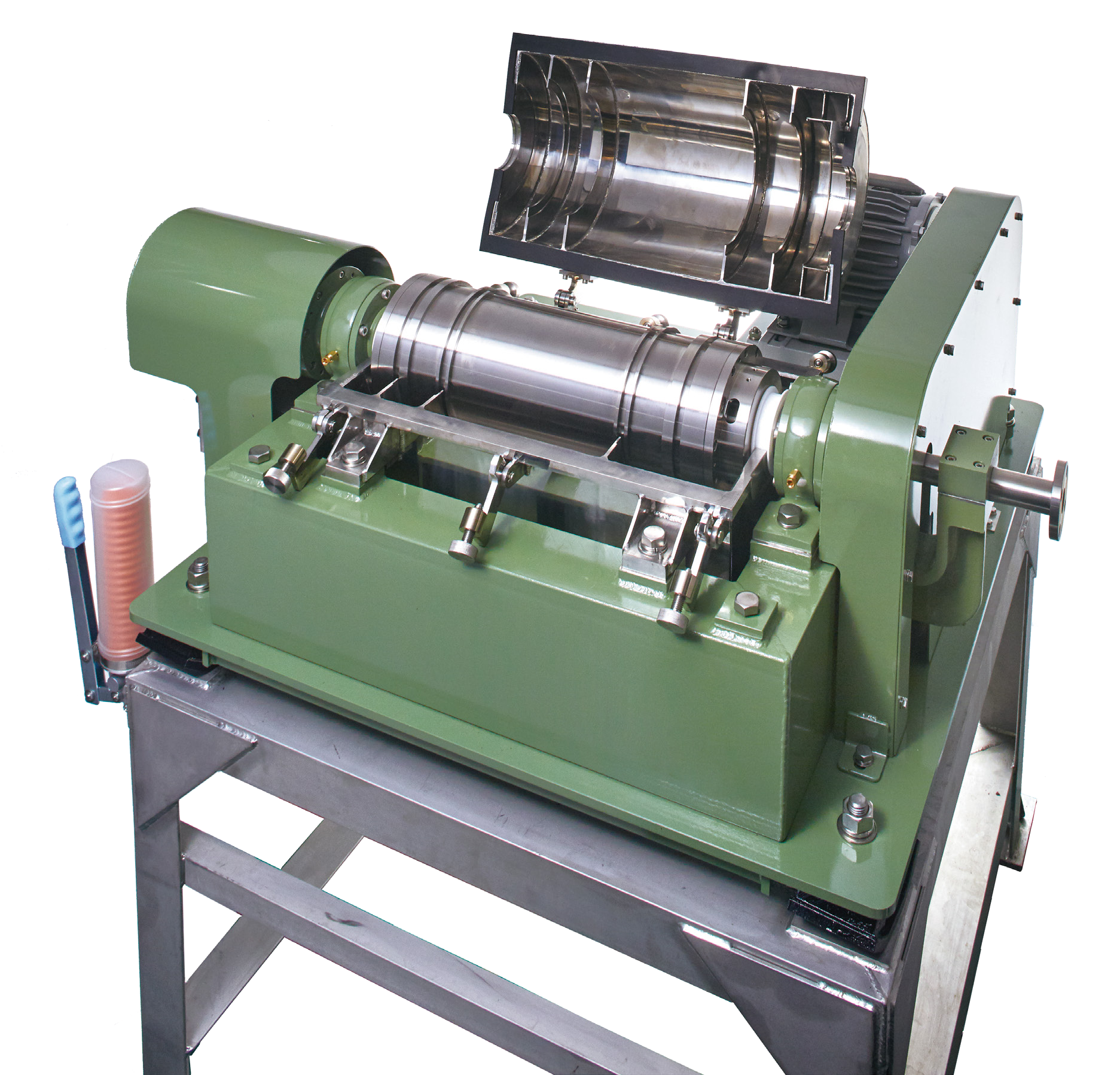
Options for your application and installation
Washing nozzles
Assist cleaning of the casing interior and bowl exterior.
Forward / reverse mechanism
Assists removal of solids remaining inside the bowl.
Chutes and movable frame
Direct recovered material to its destination, or provide dedicated casters for moving the machine.
Explosion-proof and purge configurations can be discussed after reviewing the solvent and installation environment.
Frequently asked questions
What particle size can be separated?
The catalog gives an indicative particle size of 50 µm or larger. Actual separation depends on particle density, concentration, shape and liquid viscosity; confirm with the real feed.
Can it handle high solids or high viscosity?
Flowability and the ability to pump the feed are starting points. We also review the concentration, viscosity, throughput and required separation result.
Can the machine be cleaned or dismantled?
Cleaning nozzles and a forward / reverse mechanism can assist cleaning. Please consult us before cleaning or maintenance that involves dismantling.
Can I check the result before purchase?
We can arrange sample testing. If you need to test at your own site, ask about demo rental; availability and arrangements will be checked for your location.